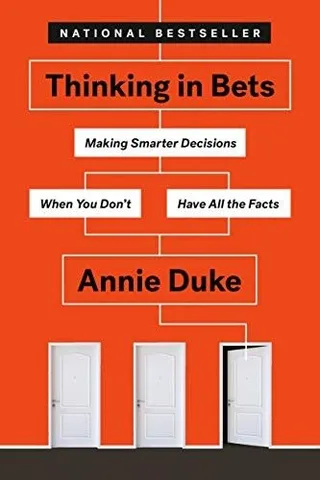
Thinking in Bets
Library · Psychology, risk and decisions
- Author: Annie Duke
- FinSimLab editorial rating: 4/5
- Reading difficulty: Moderate
- Finance level: Intermediate
- Topics: Psychology, Investing
- Published: 2018
- Length: Medium length
FinSimLab's own rating, based on usefulness, clarity, rigour, how current it is and what it adds to your learning. It is not a reader review score.
How to decide when you do not have all the facts, and how to judge your decisions afterwards without being fooled by the outcome.
What is it about?
Duke, a professional poker player trained in cognitive psychology, suggests treating every decision as a bet: you choose with the information you have and accept that the outcome also depends on luck. She explains why we judge decisions by how they turned out, how to spot that trap and how to review what you do with other people so you actually learn. The examples come from poker, sport and business.
What does it give you?
- Why a good outcome does not prove a good decision, nor a bad one a bad decision.
- How to express what you believe in probabilities rather than certainties.
- How to review your investment decisions without rewriting what you knew at the time.
Is it for you?
People who already invest and want to judge their decisions by the process, not by how this year went.
When to read it: Become a better investor. You already invest and want to decide better.
Where does it apply?
Universal. Its ideas do not depend on the laws, taxes or products of a particular country.
Concepts it covers
Deciding under uncertainty, Luck and randomness, Biases
What does it not give you?
- Anything investing-specific: the examples are from poker, sport and business.
- The underlying research on biases: for that, see Thinking, Fast and Slow.
How does it explain it?
Practical and case-based, with betting as the thread and proposals for deciding as a group. (Practical, Case-based)
What does it add?
It adds something other books do not cover: a method for deciding under uncertainty and learning from your decisions without judging them only by the outcome.
Already read something similar?
- It shares the role of luck and why an outcome proves nothing with Fooled by Randomness. If you have read Fooled by Randomness, this one mainly adds a practical method to decide and review decisions with other people. Fooled by Randomness
- It shares biases and the limits of our judgement with Thinking, Fast and Slow. If you have read Thinking, Fast and Slow, this one mainly adds how to bring it to concrete decisions, with examples from poker and business. Thinking, Fast and Slow
What can you read next?
Related Academy guides
- What is risk tolerance in investing and why it matters
- How to analyse any investment: avoid mistakes and spot risks
- FOMO Investing: How Fear of Missing Out Destroys Portfolios
Calculators to put it into practice
More psychology, risk and decisions books
Descriptions written by FinSimLab for educational purposes. They do not summarise the books and are not investment advice.