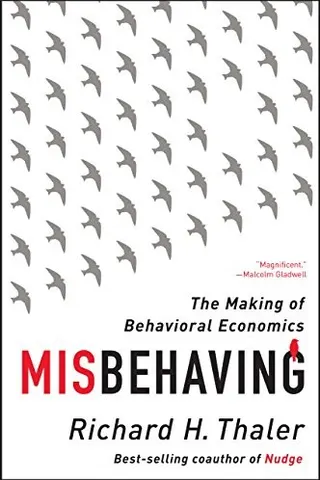
Misbehaving
Library · Psychology of money
- Author: Richard H. Thaler
- FinSimLab rating: 4/5
- Reading: Moderate
- Finance level: Intermediate
- Published: 2015
How behavioural economics made its way against the idea that people always decide rationally.
What it covers
Thaler tells first-hand how behavioural economics emerged and which anomalies drove it: mental accounting, the endowment effect and the tendency to put off saving. It is an easy read that helps explain why saving and sticking to a plan are so hard.
What you will learn
- What mental accounting is and how it shapes spending and saving.
- Why we value what we already own more (the endowment effect).
- How automatic contributions help you save without relying on willpower.
Who it is for
People who want to understand why good saving intentions fail and how to design habits that work.
Concepts
Financial behaviour, Biases, Automation
What you will not learn
How to invest or which products to choose.
Already read a book on this?
- It shares biases and behavioural economics with Thinking, Fast and Slow. If you have read Thinking, Fast and Slow, this one mainly adds how it applies to saving and spending, in a lighter read. Thinking, Fast and Slow
We suggest you continue with
- I Will Teach You to Be Rich (in the "I want better money habits" path)
- Thinking, Fast and Slow (in the "I want to understand how I decide about money" path)
Related Academy guides
- The 50/30/20 rule: how to budget your money
- What is Dollar Cost Averaging (DCA) and why it works
- How much should you invest each month?
Put it into practice
More psychology of money books
Descriptions written by FinSimLab for educational purposes. They do not summarise the books and are not investment advice.